

Welcome to the definitive guide to one of Italy’s most treasured and fiery culinary exports: ’Nduja di Calabria.
If you’ve seen this vibrant, spreadable salami popping up on menus across Australia, from Melbourne’s laneway pizzerias to Sydney’s finest delis, and wondered what all the fuss is about, you’ve come to the right place.
As direct importers of the finest Italian foods, we at Assaggia have a deep respect for the tradition and flavour packed into this unique Calabrian delicacy.
This is more than just another spicy sausage. It’s a taste of history, a testament to the resourcefulness of Southern Italian cucina povera (peasant cooking), and a versatile powerhouse that can elevate your cooking from simple to sublime.
Forget everything you thought you knew about cured meats; ’nduja is in a class of its own.
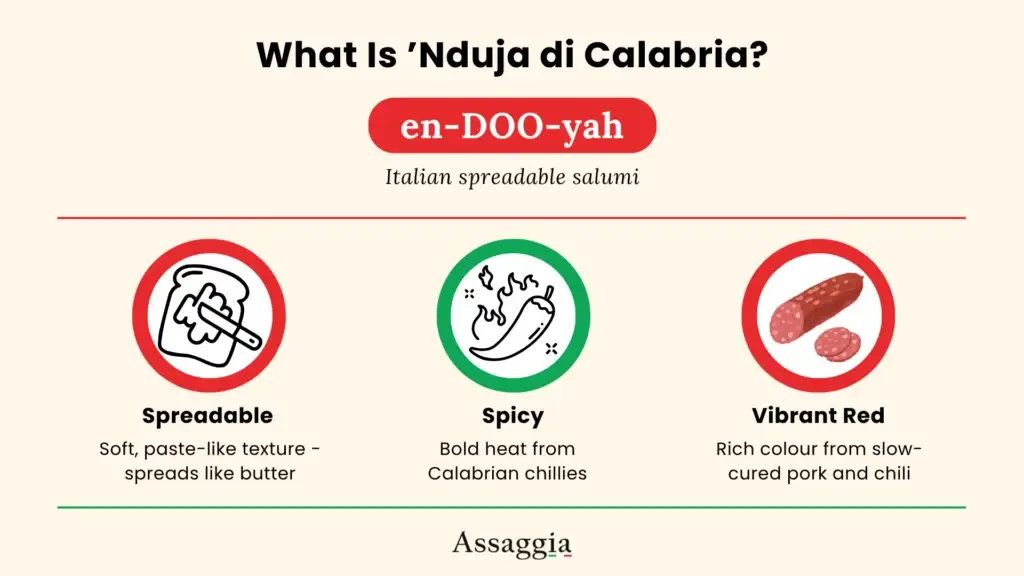
Let’s tackle the most common question first. It’s pronounced en-DOO-yah. Say it with a flourish, and you’re already halfway to sounding like a seasoned connoisseur.
’Nduja is a soft, spicy, and intensely flavourful spreadable pork salume. Unlike firm, sliceable salami, ’nduja has a loose, pâté-like texture, thanks to its high percentage of fat.
It’s this unique consistency that allows it to be spread on bread, stirred into pasta sauces, or dolloped onto pizza, where it melts into pools of savoury, spicy goodness.
Its defining characteristics are:
It’s a product born of necessity and perfected over centuries, a true representation of the bold and uncompromising flavours of its homeland.
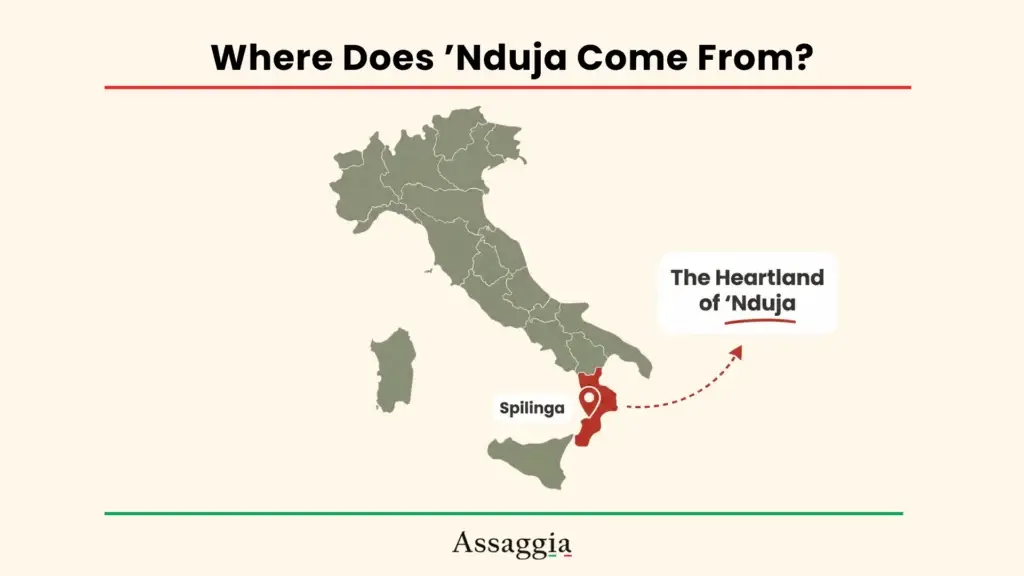
More specifically, its heartland is the small town of Spilinga, a municipality with fewer than 2,000 inhabitants in the province of Vibo Valentia.
Here, making ’nduja is not just a trade; it’s a way of life. For generations, every family has raised and butchered their own pigs, with the annual tradition culminating in the creation of this local speciality.
Spilinga is so synonymous with the product that it hosts the annual ’Nduja Festival (Sagra della ‘Nduja) every August, a celebration that draws visitors from all over the world.
Producers in Spilinga have been fighting for years to gain Protected Geographical Indication (PGI) status to protect the authenticity of ’Nduja di Spilinga from imitations, ensuring that only products made in this specific area, using traditional methods and local ingredients, can bear the name.
The name ’nduja itself is thought to derive from the French andouille, a type of smoked pork sausage, likely introduced to the region during the Napoleonic period in the early 1800s. However, the Calabrians made it their own, transforming it with their most prized local ingredient: the fiery peperoncino.
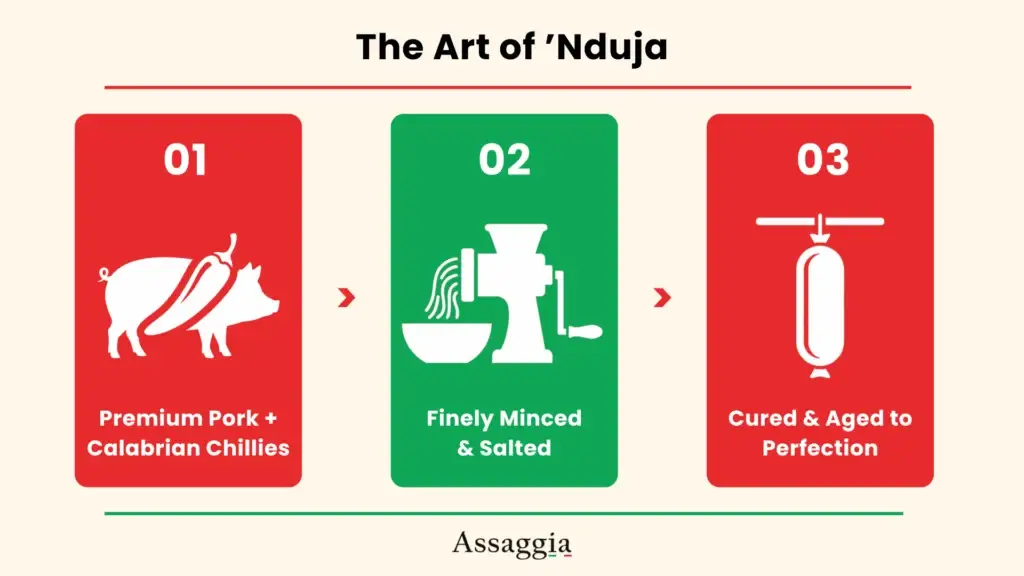
The production of ’nduja is a masterclass in simplicity and quality. There are only three core ingredients: pork, salt, and a significant amount of Calabrian chilli peppers.
| Format | Description | Best For | Price Guide (AUD) |
|---|---|---|---|
| Whole Casing | The most traditional form, a large, semi-cured sausage. | Delis, restaurants, serious home cooks. Offers the most authentic flavour. | Varies by weight |
| Glass Jar (Vasetto) | 'Nduja that has been removed from its casing and packed into a jar. | Easy pantry storage, casual home use, spreading on toast. | $15 – $30 |
| Sac à Poche (Piping Bag) | A modern, incredibly convenient format. | Home cooks and chefs who want precision, ease of use, and no mess. Perfect for squeezing directly onto pizza or into pans. | $11.99 – $22.99 |
At Assaggia, we’ve chosen to provide Easy ‘Nduja in a Sac à Poche because it offers the perfect combination of authentic Spilinga flavour and modern convenience.
The piping bag allows you to dispense exactly what you need with no waste or mess, while keeping the remaining product fresh. It’s the ideal way to bring this Calabrian superstar into your Australian kitchen.
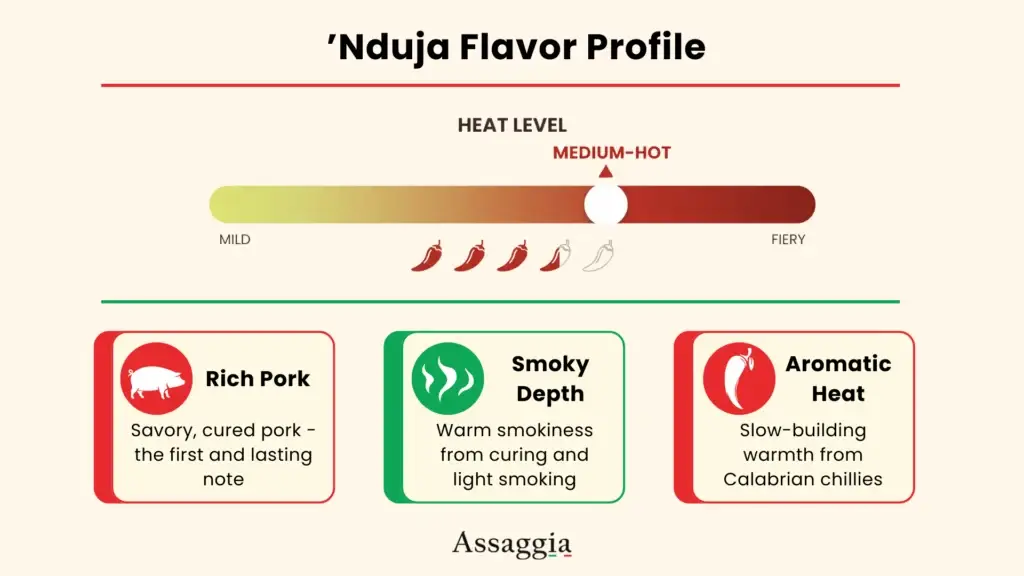
’Nduja delivers a symphony of flavour. The first note is the rich, savoury taste of cured pork, followed by a smoky depth.
Then, the chilli comes through—not as a sharp, aggressive burn, but as a warm, enveloping heat that builds slowly and lingers pleasantly. It’s a complex, umami-rich experience that is incredibly addictive.
The heat level can vary, but it’s generally considered medium-hot to hot. However, the high fat content beautifully tempers the spice, coating your palate and softening the chilli’s edge.
When cooked, the flavour mellows and deepens, infusing the entire dish with its characteristic warmth.
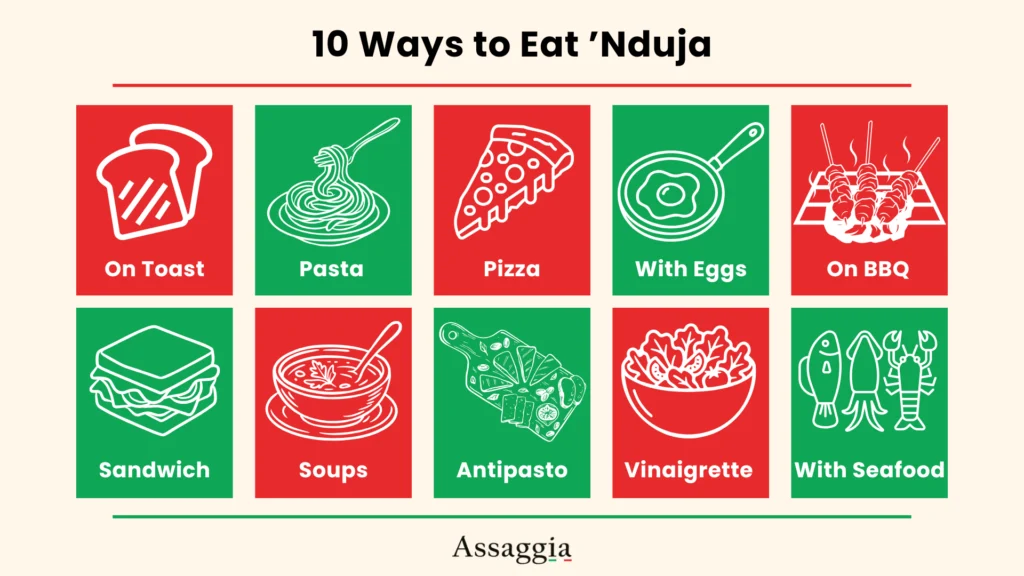
’Nduja’s spreadable nature and intense flavour make it one of the most versatile ingredients in the Italian pantry.
Here are ten ways to use it, perfect for the Australian lifestyle:
| Wine Type | Recommendation | Why It Works |
|---|---|---|
| Classic Italian Red | Cirò Rosso (Gaglioppo) | The classic regional pairing from Calabria. Its bright cherry fruit, earthy notes, and firm tannins are a perfect match. |
| Australian Red | Barossa Shiraz or McLaren Vale Grenache | A bold, fruit-forward Australian red can handle the spice, with its dark fruit flavours providing a lovely contrast. |
| Italian-Australian Red | King Valley Sangiovese | The high acidity and savoury cherry notes of Sangiovese cut through the richness of the pork beautifully. |
| Crisp White | Fiano or Vermentino | If you prefer white, choose a full-bodied, textural variety that can stand up to the flavour intensity. |
| Cheese | Recommendation | Why It Works |
|---|---|---|
| Creamy & Fresh | Burrata or Stracciatella | The ultimate pairing. The cool, milky creaminess of fresh burrata against the warm, spicy 'nduja is a textural and flavour sensation. |
| Soft & Mild | Fresh Ricotta | Whipped ricotta spread on toast with a smear of 'nduja is simple, elegant, and delicious. |
| Stretched Curd | Fresh Mozzarella | On a pizza or in a sandwich, the mild, milky flavour of mozzarella provides the perfect cheesy backdrop. |
Proper storage is key to preserving the quality of your ’nduja.
At Assaggia, we are proud to offer Easy ‘Nduja, sourced directly from Spilinga and available in a convenient sac à poche. You can have it delivered straight to your door, anywhere in Australia, ensuring you get the real deal every time.