

Walk into any Italian restaurant in Australia, and you will likely see a menu offering pizza, pasta, risotto, and perhaps a tiramisu to finish. While this sounds perfectly Italian to an outsider, an Italian would immediately recognise it as a culinary impossibility.
“In Italy, you do not eat risotto in Naples, nor do you eat pizza in Milan—at least, not if you want the authentic experience.”
Italy is not a monolith; it is a patchwork of twenty distinct regions, each with its own deeply entrenched culinary identity. Unlike France or Spain, which have been unified nations for centuries, Italy only became a single country in 1861. Before that, it was a collection of independent city-states, kingdoms, and republics. For hundreds of years, these regions developed their food cultures in near-total isolation.
This guide is your passport to understanding the regional flavours of Italy—from the buttery, truffle-laden dishes of the North to the sun-drenched, spicy plates of the South. More importantly, it will show you how to bring these authentic regional experiences into your own Australian kitchen.
Before embarking on our culinary journey, it is essential to understand why Italian food changes so drastically from one town to the next.
The answer lies in three key factors:
To summarise the fundamental differences in Italian regional cooking, here is a quick reference guide comparing the culinary philosophies of the North, Centre, and South.
| Culinary Philosophy | Northern Italy | Central Italy | Southern Italy |
|---|---|---|---|
| Primary Fat | Butter, cream, lard | Olive oil | Olive oil |
| Primary Carbohydrate | Rice (risotto), polenta, fresh egg pasta | Dried pasta, fresh egg pasta, bread | Dried pasta, bread |
| Key Proteins | Beef, veal, pork, dairy | Pork, wild boar, lamb, legumes | Seafood, pork, legumes |
| Signature Flavours | Rich, earthy, creamy, delicate | Rustic, herbaceous, simple, robust | Bright, spicy, acidic, bold |
The cuisine of Northern Italy is defined by its proximity to the Alps and the fertile Po River Valley.
The food here is rich, hearty, and designed to provide warmth during the freezing Alpine winters. You will find very few tomatoes or olive oil here; instead, the kitchen is ruled by butter, cream, and aged cheeses.
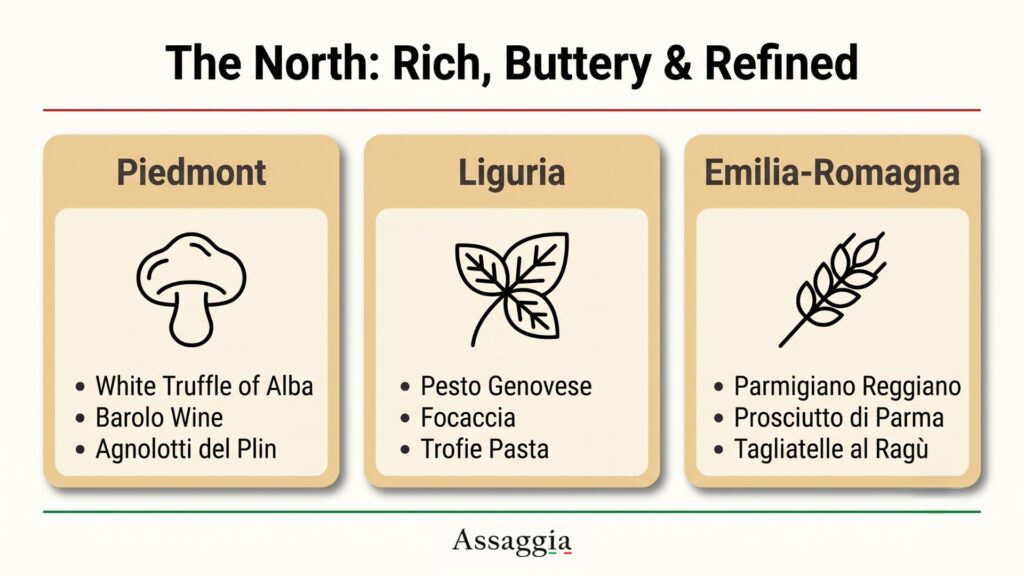
Piedmont, located in the northwest corner bordering France, is arguably Italy’s most elegant culinary region.
It is the birthplace of the Slow Food movement and home to some of the world’s most prized ingredients.
The region’s culinary identity is built on three pillars:
Piedmont is also famous for its hazelnuts, which led to the invention of Gianduia—the chocolate-hazelnut paste that eventually inspired Nutella.
Liguria is a narrow strip of coastline nestled between the mountains and the sea, known as the Italian Riviera. Because the terrain is steep and rocky, large-scale farming is impossible.
Liguria’s greatest gift to the culinary world is Pesto Genovese. Authentic Ligurian pesto is a masterpiece of simplicity, made by pounding the following ingredients in a marble mortar:
It is traditionally served with trofie, a short, twisted pasta. The region is also famous for its exceptional focaccia and farinata, a savoury flatbread made from chickpea flour.
If Italy is the food capital of the world, Emilia-Romagna is the food capital of Italy.
This broad, fertile region is responsible for producing the country’s most iconic and heavily protected ingredients.
What does DOP mean? DOP stands for Denominazione di Origine Protetta (Protected Designation of Origin). It guarantees that a product is produced, processed, and packaged in a specific geographical zone using traditional methods.
The region’s most famous DOP exports include:
Parmigiano Reggiano: The undisputed king of cheeses.
Prosciutto di Parma: The sweet, delicate cured ham.
Aceto Balsamico Tradizionale di Modena: Authentic balsamic vinegar aged for decades in wooden barrels.
Emilia-Romagna is also the undisputed king of fresh egg pasta. This is the birthplace of Tagliatelle al Ragù—the dish what Aussies call “Spaghetti Bolognese”.
Central Italy is where the Mediterranean diet lives in its purest form.
The landscape is defined by rolling hills, olive groves, and ancient hilltop towns. The cooking here is rustic, straightforward, and deeply connected to the land.
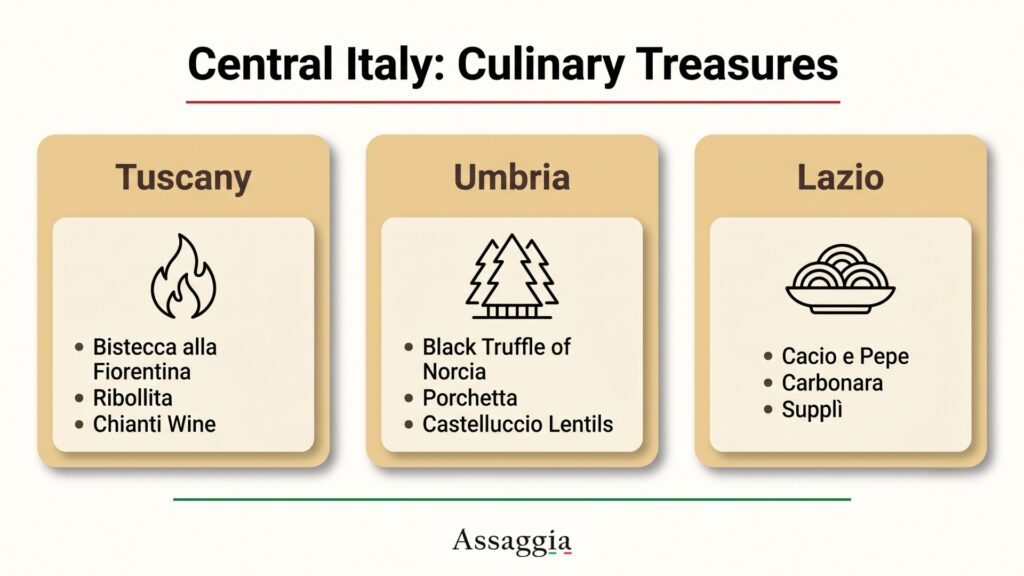
Tuscan cuisine is the ultimate expression of cucina povera, or “peasant cooking.” This philosophy dictates that nothing should ever be wasted, and that simple, inexpensive ingredients can be transformed into magnificent meals with time and care.
Stale bread is the cornerstone of the Tuscan kitchen, famously repurposed in dishes like:
When Tuscans do eat meat, they do it spectacularly. The Bistecca alla Fiorentina is a massive, thick-cut T-bone steak from the local Chianina cattle breed, grilled briefly over wood coals and seasoned with nothing more than salt, pepper, and a drizzle of olive oil.
Umbria is the only region in peninsular Italy without a coastline, and its food reflects its landlocked, forested geography.
It is known as the “Green Heart of Italy,” and its cuisine is earthy, robust, and deeply satisfying.
Umbria is famous for its pork products, particularly from the town of Norcia, which is so renowned for its butchery that pork butchers across Italy are still called norcini.
The region’s signature dish is porchetta—a whole pig, deboned, stuffed with wild fennel, garlic, and herbs, and slow-roasted until the skin crackles.
Lazio, the region that surrounds Rome, is a pasta lover’s paradise.
The culinary identity of Rome is built upon four legendary pasta dishes, all of which share a common foundation of Pecorino Romano cheese and black pepper.
Beyond pasta, Rome is famous for its street food, particularly supplì (fried rice balls stuffed with mozzarella) and deep-fried globe artichokes.
Southern Italian cooking is the food most Australians think of when they imagine “Italian cuisine.”
This is because the vast majority of Italian immigrants who arrived in Australia after World War II came from the South, bringing their recipes with them.
The food here is defined by the Mediterranean sun and sea. Tomatoes, chilli, olive oil, garlic, and seafood are the hallmarks of a cuisine born from necessity and perfected over centuries.
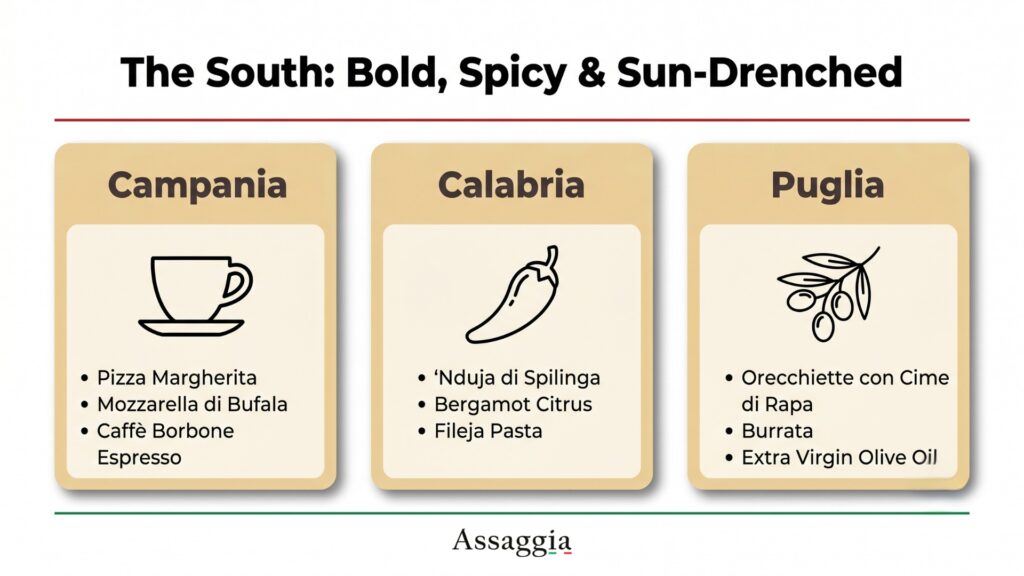
“Neapolitan espresso is typically a darker roast, often blending Arabica with a touch of Robusta for a thick, rich crema and an intense, chocolatey body.”
Calabria forms the “toe” of the Italian boot. It is a rugged, mountainous region surrounded by the sea, and its food is famously the spiciest in Italy. The Calabrian peperoncino (chilli) is treated with almost religious reverence and finds its way into almost everything.
Calabria’s most famous exports include:
Puglia, the “heel” of the boot, is Italy’s agricultural powerhouse.
It produces a massive percentage of the country’s wheat, tomatoes, and most importantly, olive oil. The landscape is defined by millions of ancient olive trees, and the food reflects this agricultural abundance.
The region’s signature pasta is orecchiette (little ears), typically served with cime di rapa (broccoli rabe), garlic, chilli, and anchovies. Puglia is also famous for its incredible dairy, most notably burrata—a shell of fresh mozzarella encasing a rich, creamy centre of stracciatella.
Sicily and Sardinia are not just islands; they are entire culinary worlds.
Because of their strategic positions in the Mediterranean, they have been conquered and settled by countless civilisations, resulting in food cultures that are proudly distinct from the mainland.
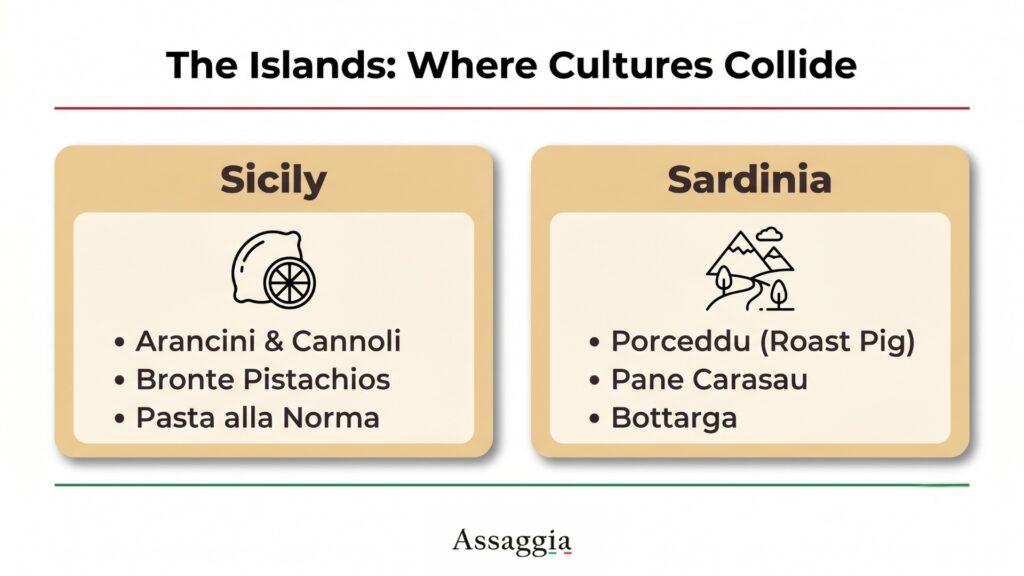
Sicilian cuisine is a vibrant, colourful mosaic of Arab, Greek, Spanish, and Norman influences.
When the Arabs ruled Sicily in the 9th century, they introduced sugar, citrus, rice, almonds, and spices like saffron and cinnamon.
This influence is still obvious today in dishes like:
Sicily is also famous for its incredible sweets, heavily reliant on local ricotta, pistachios from Bronte, and candied citrus. The cannolo—a crisp pastry shell filled with sweetened ricotta—is the island’s most famous export.
Sardinia sits isolated in the middle of the Mediterranean, and its food is deeply rooted in its ancient pastoral traditions. While you might expect an island to rely entirely on seafood, traditional Sardinian food is actually based on meat and cheese, reflecting the diet of the shepherds who lived in the rugged interior.
The most famous Sardinian culinary traditions include:
To help you navigate the diverse culinary landscape of Italy, here is a quick-reference guide to the regions we have explored, their signature flavours, and how you can experience them through Assaggia.
| Region | Key Ingredients | Signature Dish | Flavour Profile | Assaggia Product Match |
|---|---|---|---|---|
| Piedmont | White truffle, beef, hazelnuts | Agnolotti del Plin | Earthy, rich, refined | Black Truffle Oil |
| Emilia-Romagna | Parmigiano, Prosciutto, balsamic | Tagliatelle al Ragù | Savoury, complex, comforting | Artisanal Egg Pasta |
| Tuscany | Stale bread, beans, olive oil | Bistecca alla Fiorentina | Rustic, herbaceous, simple | Premium Olive Oils |
| Lazio (Rome) | Pecorino Romano, guanciale | Carbonara | Sharp, peppery, rich | Artisanal Rigatoni |
| Campania | Tomatoes, buffalo mozzarella | Pizza Margherita | Bright, fresh, intense | Caffè Borbone Coffee |
| Calabria | Chilli, pork, bergamot | 'Nduja di Spilinga | Spicy, fiery, aromatic | Easy 'Nduja / Bergamot Pasta |
| Sicily | Eggplant, citrus, ricotta | Arancini / Cannoli | Sweet-and-sour, vibrant | Artisanal Lemon Pasta |
The secret to cooking authentic Italian food in Australia is to stop mixing regions.
If you are serving a delicate Northern Italian risotto, do not follow it with a heavy, spicy Southern Italian meat dish. Instead, build your menu around a single region.
The beauty of Italian food lies in its hyper-local diversity.
From the truffle-scented hills of Piedmont to the fiery kitchens of Calabria and the citrus groves of Sicily, every region tells a story of its land, its history, and its people.
You do not need a plane ticket to experience this culinary journey. By sourcing authentic, regional ingredients, you can travel from the Alps to the Mediterranean without leaving your kitchen.
At Assaggia, we import the finest regional specialties directly from Italy to Australia—whether you are looking for authentic Calabrian ‘Nduja, Neapolitan espresso, or artisanal Sicilian pasta.
Northern Italian food is heavily influenced by its cooler climate and proximity to the Alps, relying on butter, cream, rice, polenta, and beef.
Southern Italian food is shaped by the hot Mediterranean climate, relying almost entirely on olive oil, dried pasta, tomatoes, chilli, and seafood.
Nduja originates from Calabria, specifically the small town of Spilinga.
It is a soft, spreadable pork salume that gets its vibrant red colour and intense heat from the generous addition of Calabrian chilli peppers.
Piedmont (in the north) is famous for the highly prized white truffle, particularly from the town of Alba.
Umbria (in central Italy) is famous for its abundant black truffles, particularly from the town of Norcia.
DOP stands for Denominazione di Origine Protetta (Protected Designation of Origin).
It is a strict certification that guarantees a product is produced, processed, and packaged in a specific geographical zone using traditional methods. Examples include Parmigiano Reggiano and Prosciutto di Parma.
Caffè Borbone is roasted in Naples, the capital of the Campania region.
Naples is famous worldwide for its intense, dark-roasted espresso culture, and Borbone is one of the city’s most beloved and authentic coffee roasters.
Cucina povera translates to “peasant cooking.” It is the traditional Italian philosophy of making the most out of simple, inexpensive, and readily available ingredients, ensuring absolutely nothing goes to waste.
Classic examples include using stale bread to thicken soups (like Tuscan ribollita) or using cheap cuts of meat for slow-cooked ragù.