

Walk into any café in Melbourne or Sydney, and you will find an espresso machine humming away. Australians enjoy one of the most sophisticated coffee cultures in the world, but this obsession did not happen by accident.
It is a direct result of post-war Italian migration, which brought the espresso machine, the moka pot, and the ritual of la dolce vita to Australian shores.
Yet, when Australians attempt to recreate that authentic, rich, and velvety Italian espresso at home, they often find themselves overwhelmed by the options. Terms like “Italian roast,” “Arabica vs Robusta,” and “Neapolitan blend” can be confusing.
This guide is designed to demystify Italian coffee beans, exploring the roasting traditions, regional flavour profiles, and blending philosophies that make Italian coffee unique.
Whether you are brewing with a traditional moka pot or a modern pod machine, this guide will help you find the perfect coffee for your morning ritual.
There is a common misconception among beginners that “Italian coffee beans” are grown in Italy.
In reality, the climate in Italy is entirely unsuitable for cultivating coffee plants. Instead, Italy imports green coffee beans from the “Coffee Belt” — regions across South America, Central America, Africa, and Asia.
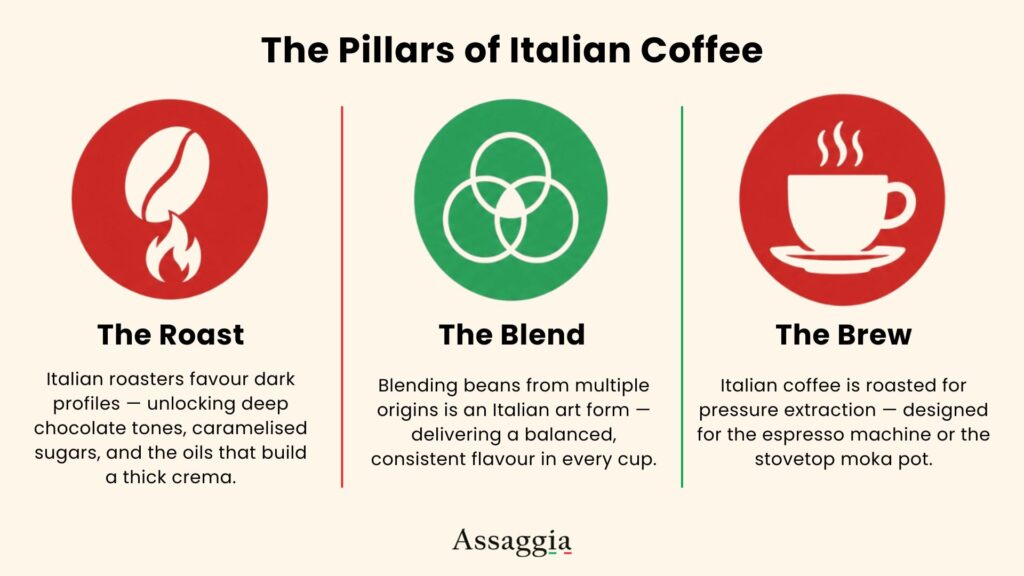
What makes coffee “Italian” is not where it is grown, but rather the philosophy applied to roasting and blending. Italian coffee is defined by three core pillars:
“Italian coffee is not a geography; it is a masterclass in alchemy. It is the art of taking raw ingredients from across the globe and roasting them into a singular, unified experience.”
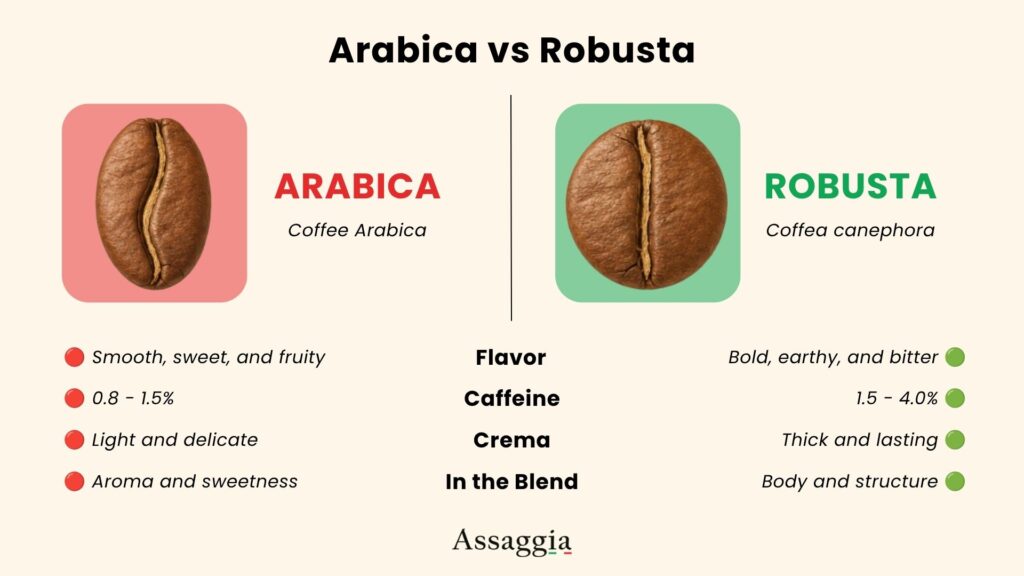
When shopping for Italian coffee beans, you will frequently encounter the terms Arabica and Robusta.
These are the two primary species of coffee cultivated for consumption, and understanding their differences is crucial for finding your preferred flavour profile.
While many modern specialty coffee shops exclusively serve 100% Arabica beans, traditional Italian roasters have long understood the value of Robusta.
A masterfully crafted Italian blend will often feature 70 to 80 percent Arabica for aromatic complexity, combined with 20 to 30 percent premium Robusta to provide body, strength, and that signature golden crema.
| Feature | Arabica (Coffea arabica) | Robusta (Coffea canephora) |
|---|---|---|
| Flavour Profile | Smooth, complex, sweet, fruity, and floral. | Bold, earthy, strong, with a characteristic bitterness. |
| Acidity | Higher acidity, offering a bright and crisp finish. | Low acidity, resulting in a heavier, more grounded taste. |
| Caffeine Content | Lower, approximately 0.8% to 1.5%. | Higher, approximately 1.5% to 4.0%. |
| Crema Production | Produces a thin, light crema. | Essential for producing a thick, rich, and lasting crema. |
| Role in Italian Blends | Provides the aroma, sweetness, and nuanced top notes. | Provides the heavy body, caffeine kick, and structural backbone. |
Coffee roasting is a transformative process.
As green coffee beans are exposed to heat, they undergo the Maillard reaction, where amino acids and sugars react to produce browning and complex flavours. As the beans roast, they expand and emit a cracking sound.
Most modern specialty coffee is roasted lightly to preserve the bright, fruity characteristics of the raw bean.
However, Italian tradition leans heavily towards medium-dark to very dark roasts. At these higher temperatures, the beans are roasted past the “second crack,” bringing oils to the surface and replacing acidic fruit notes with deep, toasted flavours.
Just as Italy’s cuisine varies dramatically from north to south, so too does its coffee. The Italian roasting tradition is deeply regional, with each major city boasting a distinct style that reflects local tastes and culture.
Naples is the spiritual home of the traditional Italian espresso.
Neapolitan coffee is unapologetically strong, dark, and robust. Roasters in the south favour a very dark roast and a higher percentage of Robusta beans.
The result is a smoky, earthy, and intense cup with a thick, syrupy crema that coats the palate. It is the perfect coffee for early mornings or a powerful after-dinner digestif.
Moving to Central Italy, the Roman style represents a harmonious middle ground.
Roasters in Rome typically utilise a medium-dark roast and a balanced blend of Arabica and Robusta.
This style yields a smooth, rich coffee with a subtle sweetness, nutty undertones, and just the right hint of traditional bitterness. It is a versatile, all-day drinking coffee.
In Northern Italy, particularly in Milan, the preference shifts towards elegance and subtlety.
Milanese roasters tend to favour lighter, medium roasts and blends that are heavily, or entirely, Arabica.
This gentler style allows the bean’s natural acidity and floral top notes to shine, producing a bright, sweet cup with flavours of honey, stone fruit, and cocoa.
| Region | Roast Style | Bean Composition | Tasting Notes | Best Suited For |
|---|---|---|---|---|
| Napoli | Very Dark | High Robusta | Smoky, earthy, dark cocoa, intense | Espresso, strong milk coffees |
| Roma | Medium-Dark | Balanced Arabica/Robusta | Nutty, smooth, rich, subtle caramel | Everyday drinking, macchiatos |
| Milano | Medium | High or 100% Arabica | Floral, sweet, bright, milk chocolate | Relaxed mornings, lighter palates |
With such a diverse range of roasts and blends available, selecting the right coffee can feel daunting. However, by breaking the decision down into a few simple steps, you can easily find a blend that suits your palate and your brewing equipment.
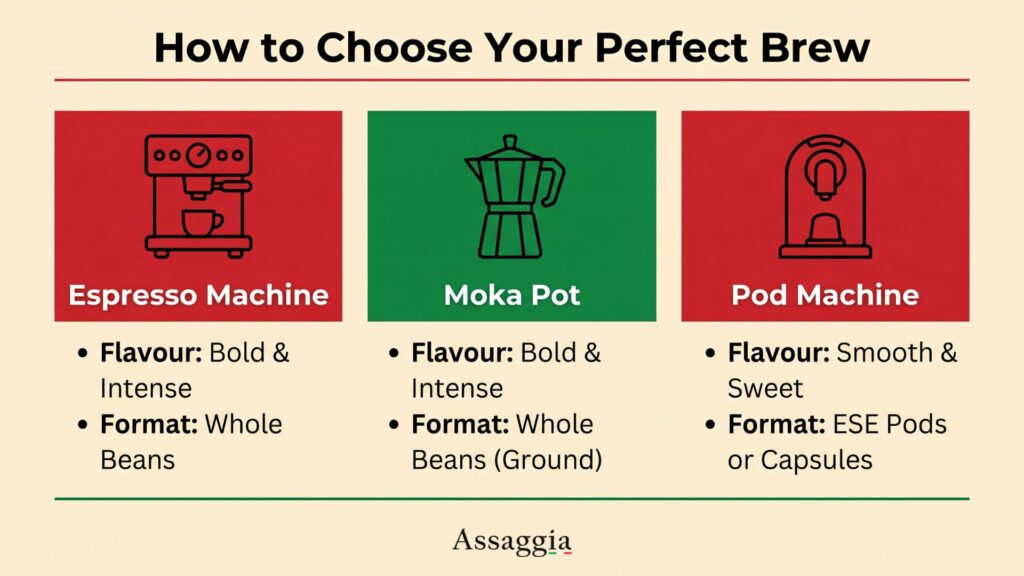
Your equipment dictates the type of coffee you should buy. If you own a traditional espresso machine or a stovetop moka pot, you will need whole beans (if you have a grinder) or pre-ground coffee specifically milled for espresso.
If you use a pod machine, you will need to seek out authentic Italian blends packaged in compatible capsules or ESE (Easy Serving Espresso) paper pods.
Do you prefer a coffee that kicks you awake with bold, smoky intensity?
If so, look for a Southern Italian or Neapolitan-style dark roast with a higher Robusta content.
If you prefer a smoother, sweeter cup with chocolate and caramel notes, opt for a Northern Italian-style medium roast that is 100% Arabica.
Authentic Italian coffee is now available in a variety of formats to suit modern lifestyles.
Whole beans offer the freshest taste, provided you grind them immediately before brewing.
ESE paper pods offer the perfect balance of convenience and environmental sustainability, delivering a pre-tamped, perfectly dosed shot of espresso without the plastic waste of traditional capsules.
or those seeking the ultimate authentic Neapolitan coffee experience in Australia, Caffè Borbone is the gold standard.
Founded in Naples, Caffè Borbone is dedicated to preserving the centuries-old tradition of Southern Italian espresso. Their blends are masterfully crafted to deliver the bold, full-bodied taste and rich crema that Naples is famous for.
Assaggia proudly imports Caffè Borbone directly to Australia, offering their signature blends in whole beans, compatible capsules, and eco-friendly ESE pods.
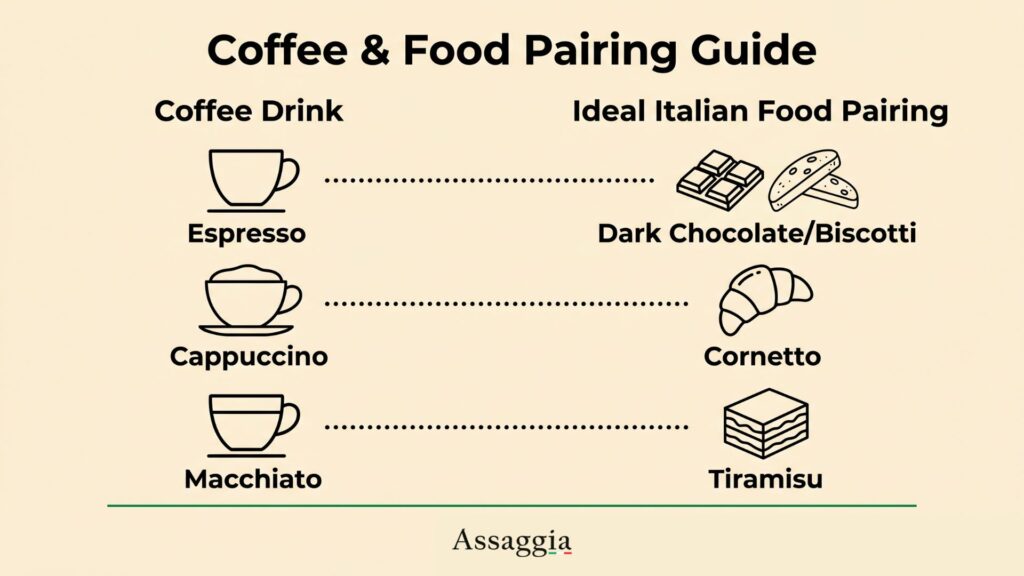
In Italy, coffee is rarely consumed in isolation; it is part of a broader culinary ritual. Pairing your coffee with the right food enhances the flavours of both the beverage and the meal.
Understanding the nuances of Italian coffee beans — from the dark, smoky roasts of Naples to the delicate, sweet blends of Milan — allows you to elevate your daily coffee ritual from a mere habit into a true sensory experience.
By choosing authentic blends that honour these centuries-old traditions, you can bring the essence of la dolce vita directly into your home.
At Assaggia, we are passionate about sharing the authentic flavours of Italy with Australia. Explore our curated selection of Caffè Borbone coffee beans, capsules, and ESE pods, and discover the perfect blend to suit your taste.
Italian roast refers to a very dark roasting style, where beans are roasted past the “second crack.” This process mutes the bean’s natural acidity and highlights deep, smoky, and toasted flavours like dark cocoa and caramel.
No. Coffee plants require tropical climates to thrive. Italy imports green coffee beans from countries like Brazil, Ethiopia, and Vietnam. “Italian coffee” refers to the country’s unique roasting and blending techniques.
Arabica beans provide sweetness, complex aromas, and higher acidity. Robusta beans provide strength, a heavier body, more caffeine, and are essential for creating the thick crema characteristic of Italian espresso.
The Miscela Blu (Blue Blend) is an excellent starting point. It offers a perfect balance of Arabica and Robusta, delivering a smooth, naturally sweet, and full-bodied espresso without overwhelming bitterness.
Absolutely. The stovetop moka pot is a staple in Italian households. Ensure you use a medium-fine grind (slightly coarser than what you would use for a commercial espresso machine) to prevent the coffee from tasting overly bitter.
To maintain freshness, store your coffee beans in an airtight, opaque container at room temperature. Keep them away from direct sunlight, heat, and moisture. Do not store coffee beans in the refrigerator or freezer, as condensation can ruin the flavour.